Tuesday, April 5, 2011

La Belle Dame sans Merci/ J.W Waterhouse.


'La Belle Dame sans Merci' is a poem by John Keats which served as a valuable store house of ideas for the visual artists during the Victorian era. Keats, who in a letter to his brother, claims to have been inspired to write this poem as the result of a dream, tells the story of a knight who meets a mysterious and ethereally beautiful woman, who captivates and enthralls him to such an extent that he is left wandering aimlessly in the woods, the captive of her snare. The painting of Waterhouse based on this poem is one of the most poetic creations, achieving a degree of emotional intensity which is unique in his oeuvre. It is reminiscent of an early watercolour by Rossetti, who had treated this subject in the 1850s, as Waterhouse was doubtless aware. The present study captures much of the same feeling and is unusual for Waterhouse is being so complete. It has almost the character of a small independent version."   

The poem 'La Belle Dame sans Merci'
John Keats.

I
O, what can ail thee, knight-at-arms,
       Alone and palely loitering?
The sedge has withered from the lake,
       And no birds sing.

II

O what can ail thee, knight-at-arms,
  So haggard and so woe-begone?  
The squirrel’s granary is full,  
  And the harvest’s done.  

III.
I see a lily on thy brow  
  With anguish moist and fever dew,       
And on thy cheeks a fading rose  
  Fast withereth too.  
  
IV.
I met a lady in the meads,  
  Full beautiful—a faery’s child,  
Her hair was long, her foot was light,       
  And her eyes were wild.  
  
V.
I made a garland for her head,  
  And bracelets too, and fragrant zone;  
She look’d at me as she did love,  
  And made sweet moan.         
  
VI.
I set her on my pacing steed,  
  And nothing else saw all day long,  
For sidelong would she bend, and sing  
  A faery’s song.  
  
VII.
She found me roots of relish sweet,        
  And honey wild, and manna dew,  
And sure in language strange she said—  
  “I love thee true.”  
  
VIII.
She took me to her elfin grot,  
  And there she wept, and sigh’d fill sore,        
And there I shut her wild wild eyes  
  With kisses four.  
  
IX.
And there she lulled me asleep,  
  And there I dream’d—Ah! woe betide!  
The latest dream I ever dream’d       
  On the cold hill’s side.  
  
X.
I saw pale kings and princes too,  
  Pale warriors, death-pale were they all;  
They cried—“La Belle Dame sans Merci  
  Hath thee in thrall!”         
  
XI.
I saw their starved lips in the gloam,  
  With horrid warning gaped wide,  
And I awoke and found me here,  
  On the cold hill’s side.  
  
XII.
And this is why I sojourn here,         
  Alone and palely loitering,  
Though the sedge is wither’d from the lake,  
  And no birds sing. 
 

Friday, April 1, 2011

April Love/ Arthur Hughes


'April Love' is a beautiful painting by Arthur Hughes, a Pre-Raphaelite painter, and was exhibited at the Royal Academy in 1856, with a quotation from Tennyson's poem 'The Miller's Daughter'.-

Love is hurt with jar and fret
Love is made a vague regret
Eyes with idle tears are set,
Idle habit links us yet;
What is love? For we forget.
Ah, no, no.

We find, in the painting, a solitary woman in lilac dress and stole looking at her name carved in the back of a tree. The painting hints at a brief quarrel between lovers, based on the perennially popular song from Tennyson, 'Tears, Idle Tears'. Scatterd petals suggest the quarrel, ivy the true constancy- and the girl's expression is between joy and pain.

The model for the principal figure was Tryphena Ford, who Hughes married in 1855.

Thursday, March 31, 2011

Symphony in White, No. 2/ J.A McNeill Whistler


Symphony in White, No. 2, also known as The Little White Girl is a painting by James Abbott McNeill Whistler. The work shows a woman in three-quarter figure standing by a fireplace with a mirror over it. She is holding a fan in her hand, and wearing a white dress. The model is Joanna Heffernan, the artist's mistress. Though the painting was originally called The Little White Girl, Whistler later started calling it Symphony in White, No. 2. By referring to his work in such abstract terms, he intended to emphasise his "art for art's sake" philosophy. In this painting, Heffernan wears a ring on her ring finger, even though the two were not married. By this religious imagery, Whistler emphasises the aesthetic philosophy behind his work.


Whistler created the painting in the winter of 1864, and it was displayed at the Royal Academy the next year. The original frame carried a poem written by Whistler's friend Algernon Charles Swinburne – titled Before the Mirror – written on sheets of golden paper. The poem was inspired by the painting, and to Whistler this demonstrated that the visual arts need not be subservient to literature. Though there are few clues to the meaning and symbolism of the painting, critics have found allusions to the work of Ingres, as well as oriental elements typical of the popular Japonisme.

Before the painting went on exhibition at the Royal Academy, Whistler pasted the poem written on gold leafs onto the frame. The idea of decorating a painting's frame with a poem was one Whistler had gotten from Rossetti, who had similarly pasted a golden paper with one of his poems on the frame of his 1849 painting The Girlhood of Mary. To Whistler, this poem underlined his idea of the autonomous nature of the painted medium. It showed that painters were more than mere illustrators, and that visual art could be an inspiration for poetry, not just the other way around.

White Rose in red rose-garden
Is not so white;
Snowdrops that plead for pardon
And pine for fright
Because the hard East blows
Over their maiden rows
Grow not as this face grows from pale to bright.
The writing of the poem was a rare and graceful tribute from the poet to the painter – a noble recognition of work by the production of a nobler one." Swinburne repaid the compliment: "...whatever merit my song may have, it is not so complete in beauty, in tenderness and significance, in exquisite execution and delicate strength, as Whistler's picture..."

Monday, March 28, 2011

The Third of May 1808/ Francisco Goya.

ArtistFrancisco Goya
Year1814


Francisco Goya, like William Blake, preserved a sense of humanity that could survive disillusion. With their prophetic and ironic insight, they were the first to face a world of passion and absurdity before which conventional heroic art was powerless.
In the work 'The Third of May 1808', Goya sought to commemorate Spanish resistance to Napoleon's armies during the occupation of 1808. Along with its companion piece of the same size, The Second of May 1808 (or The Charge of the Mamelukes), it was commissioned by the provisional government of Spain at Goya's suggestion.


'The Third of May 1808' can be said to be the first great picture in every sense of the word - in style, in subject and in intention; and it should be a model for the socialist and revolutionary painting of the present day! In the face of Murat's firing squad, the victims cover their eyes, or clasp their hands in prayer. And in the middle a man with a dark face throws up his arms, so that his death is a sort of crucifixion. His white shirt, laid open to the rifles, is the flash of inspiration which has ignited the whole design.


The painting's content, presentation, and emotional force secure its status as a groundbreaking, archetypal image of the horrors of war. Although it draws on many sources from both high and popular art, The Third of May 1808 marks a clear break from convention. Diverging from the traditions of Christian art and traditional depictions of war, it has no distinct precedent, and is acknowledged as one of the first paintings of the modern era. According to the art historian Kenneth Clark, The Third of May 1808 is "the first great picture which can be called revolutionary in every sense of the word, in style, in subject, and in intention".
The Third of May 1808 has inspired a number of other major paintings, including a series by Édouard Manet, and Pablo Picasso's Massacre in Korea as well as his masterpiece Guernica.

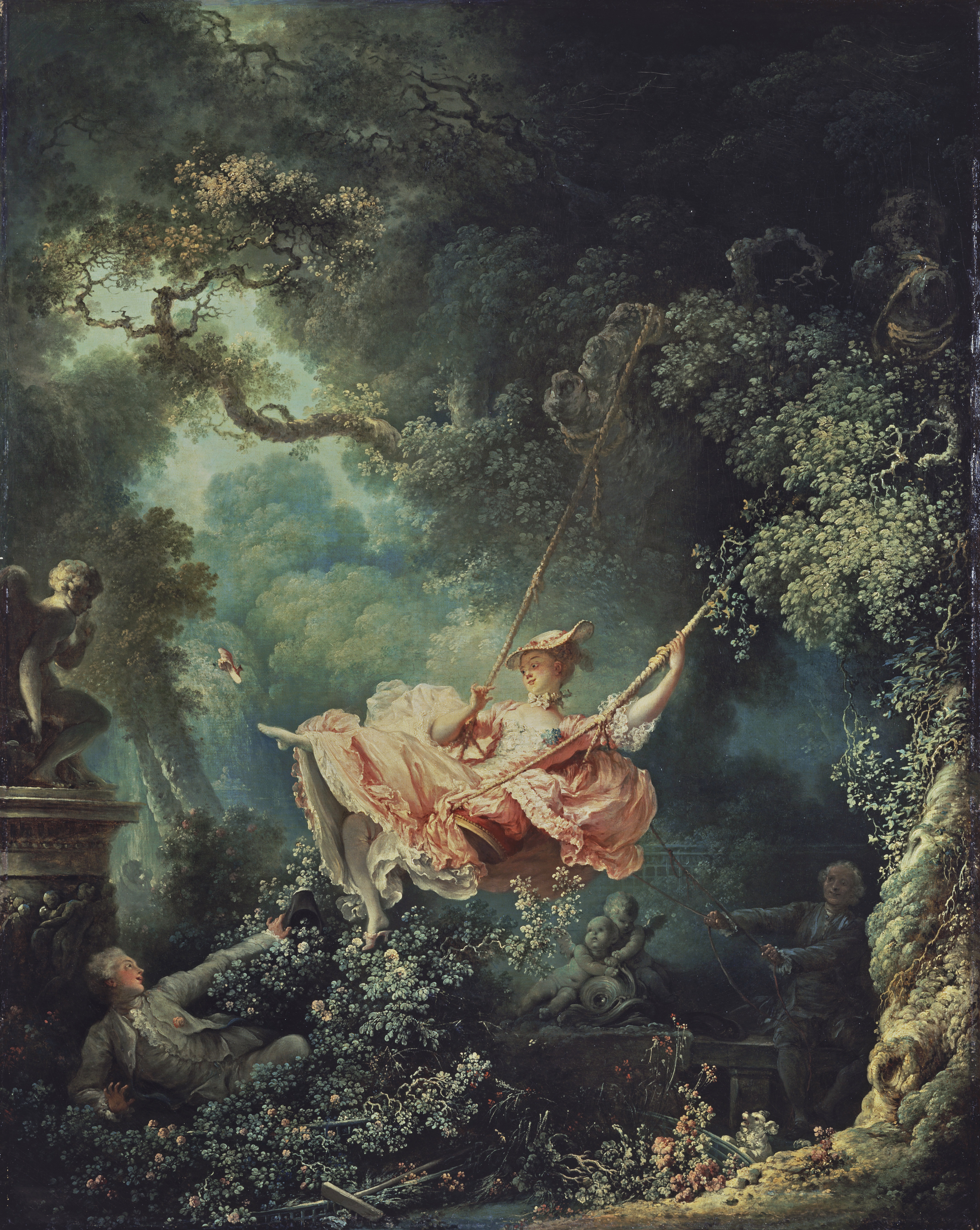
The Swing/ Jean-Honoré Fragonard

 File:Fragonard, The Swing.jpg
 

Jean-Honoré Fragonard (5 April 1732– 22 August 1806) -a French painter with remarkable felicity, exuberance and hedonism....his most important works being genre paintings conveying an atmosphere of intimacy and velied eroticism. The influence of Fragonard's handling of local colour and expressive, confident brushstroke on the Impressionists (particularly his grand niece, Berthe Morisot, and Renoir) cannot be overestimated.

 'The Swing' is one of his most popular works. In this painting, the woman is actively enjoying herself, but she is the man's "object" from four different viewpoints- the painter, Fragonard, the patron, Baron de Saint-Julien, the old cleric pushing the swing and ofcourse the suitor, who is looking up her dress!

Her power, on the other hand, resides in her seductiveness, which is displaced onto her shoe and thus is not as permanent as the man's power. For having been kicked into the air, the shoe must fall. And in doing so, the shoe itself becomes a metaphor for the proverbial 'fallen woman'!

Wednesday, March 23, 2011

Two Haystacks/ Claude Monet

Monet Haystacks


The haystacks were neutral receptacles for light. But that was their point, for Monet wanted to show fifteen of the infinite varieties of light effect that could be drawn from a motif at different times of day, in different weathers. Each haystack was meant to be seen as a sample of something both commonplace and endless, that could blot up all the inspection and discrimaination a human eye can bring. "Eternity in a grain of sand/ and Heaven in a flower."

Monday, March 21, 2011

La Grande Jatte/ Georges Seurat.


'La Grande Jatte' by Georges Seurat is an example of the popular theme of leisure and pleasure dominant in the art of the 1870s. According to T.J Clarke, "within this context of the seemingly repectable place, women have been and will be corrupted by men, and innocence will be kept ot lost."
Seurat's strict geometric treatment of form has reduced them to mannequins, denying them character or individuality. The bourgeoisie are as trapped as their rigid social conventions as the workers are oppressed by the solid band of industrial buildings.

The very science of his colors, the precision of his outlines, the fixity of each figure within its own boundaries and hence social space, provided a pictorial language which viewers recognized. It articulated the modernness of the scene in a way that was not anecdotal nor humorously ironic, but insistently formal - like the modern life itself was turning out to be!